Wednesday, February 27, 2013

Death of Maria Feliciana Arballo

 
Much has been written concerning Maria Feliciana Arballo or Arbayo. She is my 6th Great Grandmother and was born in 1755, presumably at San Miguel de Culiacan, in Sinaloa, Mexico. Feliciana is well known as "the Bold Widow" or "the Merry Widow" of the 2nd Anza Expedition of 1776. Feliciana died after November 5, 1818 in San Diego, of old Alta California; likely just before the end of the Mexican War of Independence from Spain in 1821.


Tubac Presidio circa 1775
Her birthplace, San Miguel de Culiacan was founded in 1531 by the Spanish Conquistador Nuño Beltrán de Guzmán. That same decade, it was the end place of the nearly 10 year long journey of Cabeza de Vaca and few survivors of Narváez Expedition. In 1540, the Spanish explorer Francisco Vásquez de Coronado set out from Culiacán to explore what is now the southwestern United States in his fruitless search for the famed city of gold, Cibola. Settlers from Europe came to Culiacán, and in the following centuries, Culiacán grew in population but existed as a quiet village. In 1775, the Viceroy of New Spain authorized Juan Bautista de Anza, the commander of the Tubac Presidio, to lead a 2nd expedition north to establish a presidio and mission at present-day San Francisco. Anza enlisted volunteers in various villages and areas around Culiacán, Mexico, and the selected recruits gathered at the Presidio of San Miguel de Horcasitas, Sonora’s provincial capital. José Joaquin Moraga was Anza’s lieutenant and Franciscan Friar Pedro Font was the expedition chaplain. Two other Franciscan Missionaries, Fathers Garcés and Exiarch, were to accompany the expedition as far as the crossing of the Colorado River at Yuma. The expedition’s final staging area was at Tubac. Just three weeks prior to the expedition’s arrival there, an Apache Indian attack drove off a herd of about 500 horses, which forced the group to depart without needed fresh mounts. Supplies included six tons of flour, beans, cornmeal, sugar, and chocolate, which were loaded onto, and off of, pack mules every day. Other necessaries, from shelter and sleeping supplies to cooking kettles to iron needed for making horseshoes, added yet more tonnage. 
Juan Bautista de Anza by Fray Orsi 1774
While many accounts indicate that Maria Feliciana Arballo was born in Sinaloa, Mexico some other accounts claim that she was born in Spain. By either account, it has been traditionally indicated that Feliciana came from a well to do Spanish family and that she had defied her parents and the social mores of the time by marrying below her caste level, to Juan Jose Gutierrez in 1768, when Feliciana was but 13 years old. Gutierrez was a mestizo (mixed Indian and Spanish blood) soldier in Captain Anza's service. Their marriage and the difficulties a "mixed" marriage such as this might have produced could have played some part in the Gutierrez family's decision to join the second Anza Expedition to California, when Feliciana was 20 years old with her husband and two young daughters, as it provided a possible chance to escape the existing rigid class society that based much upon skin color and race. Typically, most expedition members were recruited from impoverished mixed race families. They were paid the equivalent of two years sailor's wages, promised five years of rations, provided with camp gear, clothing, livestock and weapons, and possible land grants in the new territory; all authorized and funded by the Spanish Crown.
A recent historical discovery at the Cathedral of Culiacan, the wedding records of Maria Feliciana Arballo and Juan Jose Gutierrez describe Feliciana as a "mulata libre”, or a free black woman of either African or mixed African and Hispanic ancestry. If this is a more accurate description of Feliciana's racial heritage, then the story and shock of a high born woman of Spanish descent marrying a mestizo soldier is understandably lessened. The classification of race throughout this period varies widely among the records of soldiers, settlers and families. In some cases, individuals race evolved over the course of time, some eventually achieving the coveted designation of “Espanol”, which indicated pure Spanish blood. In some cases, siblings from the same families would have differing racial designations which indicates that there was likely no proscribed system for classification or that it was left to the determination of the recorder. Other considerations that came into play were later Alta California presidial requirements that a certain percentage of “Espanol” soldiers be enlisted in the ranks. So simply reclassifying a mestizo soldier to an Espanol designation benefitted both the individual socially, and the presidio's company when records were conveyed to the powers of New Spain.
Just weeks prior to the expedition’s departure, Feliciana's husband, Juan Jose Gutierrez, was killed during an Apache Indian attack. Whether this attack was the same as the one where the expedition lost their horses is unclear. Gutierrez' death, under normal circumstances, would have disqualified Feliciana and her daughters from now accompanying the expedition as they would be without the protection and guidance of a male family leader. It is unknown what arrangements, arguments or pleadings Feliciana Arballo used but de Anza let the widow and her daughters remain as part of the expedition even in the face of the strenuous protest and objections of the Expedition's religious leader Fray Pedro Font. Feliciana's problems with Fray Font would continue during the long trip to California, as indicated by other instances of Font's rebukes and criticisms of the young widow (and of continuing complaints made to Anza during the course of the journey). Regardless, the young widow Arballo made the trip north on horseback with her two daughters, 6 year old María Tomasa Gutierrez, and 4 year old María Estaquia Gutierrez; the one child before her and one behind.
Anza's list from September 1775 shows Feliciana in the following grouping: Agustin de Velenzuela, 30; Petra Ignacia de Ochoa, 20; Maria Seferina Valenzuela, 3; Maria Feliciana Arballo, 25; Maria Tomasa (Gutierrez), 4; and Maria Eustaquia (Gutierrez). This group is stated as being recruited on April 6th, 1775. Other notable members of the 1776 Expedition (as it applies to this history specifically), were the family members of Santiago de la Cruz Pico, whose son José María Pico would marry Feliciana's daughter María Estaquia Gutierrez some thirteen years later, and who she likely came to know as a boy of eleven years old, while he accompanied his family on the Expedition. Jose Maria Pico and Maria Estaquia Gutierrez would become the parents of Pio Pico, the last Mexican governor of California, and Mexican General Andres Pico. Also of interest is the family of the soldier Ignacio María Gutierrez, with his wife, Ana María de Osuna, and their three children. It seems quite possible that Ignacio Gutierrez was potentially a relative of Feliciana's deceased husband Juan Jose Gutierrez. Whether this is true or that it had any additional bearing upon Maria Feliciana Arballo being permitted to remain with the Expedition is unknown.

Mural Fragment of a Franciscan Friar
Perhaps the most notorious and well documented altercation between Feliciana Arballo and Fray Font came on December 17, 1775 when the parties of the expedition, who had separated over a week earlier at the Santa Olalla camp, south of Imperial County, rejoined. Anza had divided them into groups to avoid depleting the limited water sources that were available; the three groups, plus a fourth of the vaqueros and cattle, made the trek separately. An additional reason for separating the vaqueros may have been the difficulties and dangers of controlling the large herd of longhorn cattle. Following a treacherous river crossing, the expedition made camp near the present Salton Sea (which did not exist at this time). The expedition had lost numerous livestock to exhaustion, starvation and thirst during this unusually cold and harsh winter of 1775. Yet many travelers who had been ill had seemed to improve in health during the march, "…may God be thanked," said Font. That night at their camp on San Felipe Creek "with the joy at the arrival of all the people, they held a fandango [a jubilant Andalusian-style dance and feast]," wrote Font. But to the irritation of the strict friar, who himself had been sick and ill tempered for much of the journey, the colonists celebrated with bawdy songs led by Maria Feliciana Arballo herself. The fandango was described by Font as "somewhat discordant, and a very bold widow who came with the expedition sang some verses which were not at all nice, applauded and cheered by all the crowd."  
San Felipe Creek. Site of the celebratory fandango.
Font made no secret of his preference for prayer as appropriate celebration over drink and dance. At his next Mass, Fray Font further scolded the colonists for their behavior. "I said Mass and in it spoke a few words about the fandango of last night, censuring the performance, saying that instead of thanking God for having arrived with their lives and not having died from such hardship, as the animals did, it appeared that they were making such festivities in honor of the Devil. I do not think the commander liked this very much, for he did not speak to me once during the whole morning." In yet another instance, after an earthquake near the Mojave Desert, Font said it was "retribution for the coquetry of Dona Maria." In Font’s opinion, it is clear that Feliciana Arballo, "the Bold Widow", did not play the traditional and required submissive and modest role assigned to women of her time and that she, by dancing and singing in public, rejected the social controls that normally governed Spanish women's actions.
 
Mission San Gabriel
The Anza Expedition reached San Gabriel on February 21st, 1776 for rest and resupply for their continuing journey to Monterey. Whether due to Feliciana's having reached a point where she no longer wished to continue her confrontations with Pedro Font or if there was truly a romantic interest, Maria Feliciana Arballo was courted by, and caused yet another minor sensation by leaving the Expedition, and quickly married another mestizo soldier stationed at San Gabriel, Juan Francisco Lopez, on April 7th, 1776. Lopez was a native of Baja California who had came with the Portola Expedition to establish missions and presidios in California with Francisco Serra in 1769. The marriage ceremony was performed by Fray Francisco Garces, the missionary who de Anza had left at the confluence of the Gila and Colorado Rivers and sent up the Colorado River to meet and convert the Mojave Indians. Garces rejoined the group at San Gabriel. Fray Garces was killed 3 years later in the Yuma uprising of 1779. Among the witnesses to the Lopez Arballo marriage were the California Indian Sebastian Tarabal, a member of Portola's 1769 expedition who had previously fled Mission San Gabriel, with his wife, to Sonora and served Anza as a guide on both expeditions; Anza expedition member Ignacio María Gutierrez who was perhaps her brother in law or relative of her first husband; also present was my 8th Great Grandfather, Juan Jose Dominguez, another Portola expeditioneer and the later grantee of the 75,000 acre Rancho San Pedro in 1784. And so again, Arballo defied, not once but twice, (if she was indeed of pure Spanish descent) the caste and strict color constraints of Hispanic culture by marrying soldiers both of whom were of mestizo or mixed blood. Feliciana married beneath her class and caste, defied priest's advice, resisted male authority and direction, and continually and repeatedly acted boldly in the public sphere, effectively subverting the gender requirements of proper behavior for a woman of her time.

A Presidio Soldier 1778
While Maria Feliciana Arballo was certainly unusual for her gender and willful independence and defiance of one of the Expedition's leaders, she did have the seeming and continued support from the chief commander of the Expedition in Captain de Anza who saw her as an important morale booster for the company. During the earlier fandango, another member of the expedition who was escorting the young widow, apparently was also offended by Arballo's celebration and chastised her and even physically abused her in front of the party. De Anza is said to have come out of his tent, stepped in and stopped the man's abuse of Arballo. Fray Font wrote that "The Commandeer, hearing of this, sallied forth from his tent and reprimanded the man for chastizing her." Fray Font interjected that "Leave him alone, sir, he is doing just right!" De Anza replied that "No, Father, I cannot permit such excesses while I am present." Fray's final criticism of de Anza comments that "He [de Anza] guarded against these excesses, indeed, but not against the scandal of the fandango, which lasted until very late." Like de Anza, most missionaries (although clearly not Pedro Font) and military officers alike acknowledged the necessity of women's presence as a predominant factor in the success of any colonization effort.

Another interesting episode of a disagreement between Font and Anza is recorded in Fray Font's diary where he protests Anza distribution of brandy to the soldiers on Christmas Eve:
I learned at night that because it was Christmas Eve refreshments were being given to the soldiers; and in order if possible to prevent a drunken carousal, after dinner I said to the commander: "Sir, although my opinion is of no value and I do not cut any figure here, I can do no less than to tell you that I have learned that there is drinking today."
"Yes, there is," he replied.
"Well, Sir," I continued, "I wish to say that it does not seem to me right that we should celebrate the birth of the Infant Jesus with drunkenness."
"Father," he said, "I do not give it to them in order that they may get drunk."
"Clearly this would be the case," I said to him, "because then the sin would be even greater, but if you know that they are sure to get drunk you should not give it to them."
He said to me then. "The king sends it for me and they deliver it to me in order that I may give it to the soldiers."
"This would be all right at the proper time," I replied. "But I understand that to be in ease of necessity."
"Well, Father," he said, "it is better that they should get drunk than to do some other things."
"But, Sir," I replied, "drunkenness is a sin, and one who cooperates also sins, and so if you know that a person will get drunk on so much you should give him less, or none at all."
He did not say any more and I went to my tent without being able to prevent this disorder, because the commander had already made up his mind to distribute the liquor. And so he immediately gave it to the people, a pint to each one, saying in a loud voice:"Be careful that you don't get drunk, because if any one is found drunk outside of his tent I'll punish him."
With this he satisfied his conscience, and the people that night were very noisy, singing and dancing from the effects of the liquor, not caring that we were in so bad a mountain in the rain, and so delayed with the saddle animals and the tired and dead cattle. Such is the rule of those absolute lords, in evidence of which I have related this incident.
Alta California was a vast unpopulated land in 1775. The 2nd Anza Expedition effectively doubled the population of the territory and brought much needed new blood and potential for familial interaction that was sorely limited. Alongside agriculture, hunting, horsemanship and other ostensibly male dominated practices and diversions; practices of brutal, sexual violent attacks were perpetrated against females regularly (especially native women), whether in the form of rape, beatings or outright murder, often with little risk of punishment or interest in pursuing the perpetrators. Arballo, in some ways, did more than simply defy Fray Font's attempts to control her actions and attitude. In a sense she transposed their positions of power in a way that allowed her, arguably among the weakest and least valued in the company, to assume a voice that allowed her a level of power and strength in a society where women, and certainly a widowed woman, typically lacked any voice or say concerning any decisions that were to be made. While Feliciana's actions, disobedience and resistance to the existing power structure may only have stemmed from a spirit too strong to be subdued and were only examples of her being the person that she was. Her actions in today's view reaches somewhat into an almost political realm. By acting publically and succeeding in many cases, despite punishments, rebukes and even disdain from women within her own social class, Feliciana Arballo showed by example that the new world had indeed been reached and that while the road ahead was still a rocky one by any standards there were new opportunities for women to achieve and have a say, in at least some small part, their own destiny and future. It is all the more impressive considering what women of all castes and races risked during this early era of California history.
As mentioned previously, Feliciana’s daughter María Estaquia Gutierrez married José María Pico, the parents of Pio Pico. Her second daughter with Juan Jose Gutierrez, Maria Tomasa, married Juan Jose Sepulveda, another early progenitor of one of the most prominent Spanish-Mexican families in the early days of California.
Jose Joaquin Juan Pedro Verdugo and Maria Basilia Perez
Maria Feliciana Arballo's life after her marriage to Juan Francisco Lopez, while surely as rich and varied as her earlier life, has proven to be is much less documented with such detail.
  • My 6th Great Grandparents Maria Feliciana Arballo and Spanish soldier Juan Francisco Lopez were the parents of:
  • My 5th Great Grandmother Maria Josefa Benita Lopez. Maria Josefa Benita Lopez and Francisco Salvador Vejar (or Bejar) were the parents of:
  • My 4th Great Grandmother Maria Josefa Magdalena Vejar . Maria Josefa Magadalena Vejar and Jose Joaquin Verdugo (or Berdugo) were the parents of:
  • My 3rd Great Grandfather Jose Joaquin Juan Pedro Verdugo. Jose Joaquin Juan Pedro Verdugo and Maria Basilia Perez were the parents of:
  • My Great Great Grandmother Mauricia Verdugo. Mauricia Verdugo and Jose Martin Morales Cruz were the parents of:
  • My Great Grandmother Rosa Cruz. Rosa Cruz and Reginaldo Vejar (also a descendant of Maria Feliciana Arballo) were the parents of:
  • My Grandmother Henrietta Josefina Vejar. However, there are conflicting family opinions about Henrietta's birth Father. Her birth certificate is said to indicate Vejar as the father and there is indeed a record of marriage for Rosa Cruz to Reginaldo Vejar; but my mother told me that Henrietta's father was actually Henry (Enrique) Cesena of Ensenada, Mexico. I have been unable to find much in the way of documentation on this relationship, nor on the Cesena family, in general. Henrietta Josefina Vejar (or Cesena) and Robert George Metcalf were the parents of:
  • My Mother, Barbara Jean Metcalfe. Barbara Jean Metcalfe and Donald Martin Dockins are my parents.
Rosa Cruz, seated, with Albertina Verdugo
Besides my grandmother, Maria Josefa Benita Lopez born on April 3, 1784 in Mission San Juan Capistrano, Alta California the other children of Juan Francisco Lopez and his wife Maria Feliciana Arballo were:
  • Son Ignacio Maria (Becino) De Jesus Lopez born: May 31, 1778 in Mission San Diego, Alta California. He married Maria Timotea Villalobo on May 20, 1804 at Mission San Diego, Alta California.
  • Daughter Margarita Antonia Ventura Lopez born: July 21, 1781
  • Daughter Maria Josefa Inocencia Lopez born: December 28, 1782
  • Son Juan Jose Lopez born: December 27, 1786 in Mission San Juan Capistrano, Alta California. He married Maria Eduvigis de Arce.
  • Daughter Maria Antonia Lopez born: May 10, 1789
  • Daughter Maria Juliana Josefa Lopez born: March 16, 1781 in Mission San Diego, Alta California. She married Juan Maria Osuna on February 15, 1806 in San Diego. Osuna was a soldier and corporal of the San Diego Company and settled in San Diego and took part in the Mexican Revolution of 1831. After retiring as a corporal, Osuna and his family were the first to build on the plain outside the Presidio of San Diego. Later, Juan María Osuna was granted Rancho San Dieguito, 25 miles north of San Diego along the coast, during 1836–1845. He raised cattle and horses on the ranch. Their daughter’s Felipa married Juan María Marrón, and Luguarda married José María Alvarado.
  • Daughter Maria Ignacia De La Candelaria Lopez born: January 31, 1793 in Royal Presidio of San Diego, Alta California. She married Joaquin Carrillo of San Diego, and was the mother of Francisca Benicia Carrillo who married General Mariano Guadalupe Vallejo on March 6, 1832 in the Chapel of the Presidio of San Diego. After her husband's death María Ignacia Lopez de Carrillo, was granted, in 1841, the Rancho Cabeza de Santa Rosa in Sonoma County, where she lived with her son Ramon. She is buried in the ruined mission of San Francisco Solano, at Sonoma. Her remains were laid under the font where it would receive the holy water that fell from the hands of devout worshippers.

So, in the end, Maria Feliciana Arballo played an integral part in the early days of Alta California and is the ancestress of many, many California families. The Lopez, Vejar, and Verdugo families are my direct ties but the many other families include Sepulveda, Osuna, Carrillo, Vallejo, Marron and Alvarado to name but a few.

Any corrections or additional information you may have to offer this account is most welcome.

Saturday, May 5, 2012

May 4, 1748 Death of Juan Jose Carrillo

Today's ancestor is Juan Jose Carrillo. He was born circa 1695 (probably between 1695 & 1700) and died on May 4, 1748. Some sources list his birthplace & place of death as Loreto, in Baja California Sur but another account has him dying of a snakebite at San Jose del Cabo.

San Jose del Cabo
Juan Jose Carrillo (1680 - 1748) is my 7th great grandfather on my Mother Barbara Metcalfe's side.

 Loreto Mission
What do we know about Juan Jose Carrillo? He is considered the originator of the Carrillo family name in the peninsula and up the coast into California. He had enlisted at the Presido of Loreto by 1715 and served at Loreto and several other Baja missions. Records survive from San Ignacio (1731) and Comondu (1736-42). He continued on active duty until his death, reaching the rank of Lietenant. He was literate.

San Ignacio Mission in 1908
In 1714 (when Juan was 34 years old), he married Lucia Efigenia Millan at Loreto, in Baja California Sur. She was born in Spain, the daughter Lazaro Millan. A Lazaro Millan is listed on the 1695 Sonora Muster, during the Pima Wars. Lazaro settled in Loreto and is found as a mission servant in 1730 at Comondu. Juan and Efiginia Carrillo never left Baja California. After being widowed, Efiginia lived with and was supported by her son-in-law, Juan Manuel Ruiz, at San Jose de Comondu, along with her two youngest children, Mariano and Antonia Victoria.
San José de Comondu
The children of Juan Jose Carrillo and Lucia Efigenia Millan were:
  • Jose Mariano CARRILLO b: in Loreto, Baja, California. Death: 28 JAN 1782 in Mission San Carlos de Monterey 
  • Josef Raymundo CARRILLO b: in Loreto, Baja, California. Married Petra Gonzales 
  • Isabel CARRILLO b: in Loreto, Baja, California. Married Juan Maria Ruiz 
  • Maria Matilde CARRILLO b: in Loreto, Baja, California. Death: DEC 1850 in San Juan Capistrano, California
  • Maria Ignacia de la Concepcion CARRILLO b: 1725 in Royal Presidio of Loreto, Baja California, Mexico
  • Maria Micaela CARRILLO b: 1726 in Loreto, Baja, California. Married Martin Olivera
  • Hilario CARRILLO b: ABT 1730 in Loreto, Baja, California. Married Maria Josefa Antonia DE PASOS
  • Guillermo CARRILLO b: 1736 in Loreto, Baja, California
  • Maria Antonia Victoria CARRILLO b: 1741 in Loreto, Baja, California. Married: Jose  
    Francisco DE ORTEGA in 1759 in Loreto, Baja Calif, Mexico
Hilario Carrillo's son José Raimundo Carrillo (1749-1809) was the founder of the Carrillo family in California. He came to California as a soldier, (probably with the first expedition in 1769), and rose to rank of captain. He was a commandant at San Diego, from 1807-09. He married Tomasa Ignacia, daughter of  the soldier Francisco Lugo, the ceremony was performed by Junipero Serra at San Carlos, on April 23, 1781. Jose Raimundo's early services in California were at Santa Barbara and Monterey, coming to San Diego in 1806. He was buried in the chapel on Presidio Hill, on November 10, 1809. His only daughter, Maria Antonia, became the wife of Jose de la Guerra v Noriega. His sons, Carlos Antonio de Jesus, Jose Antonio Ezequiel, Anastasio, and Domingo Antonio Ignacio, were all prominent in the early history of California.
Guillermo Carrillo is first noted on the Presidio de Loreto muster roll in 1751. He came with Rivera to San Diego in 1769 (during which trek, he was named in both journals because of his severe illness requiring him to be carried on a litter by accompanying neophytes.) He sufficiently recovered to go on to San Francisco with Portolá. Carrillo was one of eight soldiers who signed as co-petitioners the request written by José Francisco Ortega at San Diego, 1 September 1770, asking that they be returned to their homes as Gálvez had promised when the Alta California objectives were secured. However, Guillermo Carrillo stayed on at San Diego as a cornerstone of the presidio, and was transferred from jurisdiction of Loreto to that of Alta California, on 1 January 1773. He appears as corporal on muster rolls of 2 September 1770, 1 January 1775, 21 December 1777, and 1 January 1780 and was still a corporal through 1781. Guillermo Carrillo died at San Diego 5 December 1782, almost a year after the death at Monterey of his younger brother Mariano.
On 5 February and 3 September 1754, Mariano Carrillo and his sister Antonia Victoria [who would become wife of José Francisco Ortega in 1758] served as godparents at San José de Comondú where their sister Isabel was the wife of the mission guard/mayordomo, Juan María Ruiz. On 26 July 1756, Mariano enlisted at Presidio de Loreto under Captain Fernando Rivera. After Carrillo accompanied Rivera to San Diego in 1769, the captain placed him in charge of soldiers left to guard the base at San Diego while he went north to seek Monterey with Governor Portolá and most of the assembled soldiers of the two land parties. Carrillo did go north with Portolá on the second, successful search for Monterey. Mariano remained in Monterey under Pedro Fages. In 1772, now a sergeant, Carrillo wrote a fascinatingly blunt and circumstantial report complaining of Fages’s arbitrary, erratic, and unreasonable demands on the Leatherjacket soldiers. Perhaps Junípero Serra’s accompanying strong endorsement of Carrillo’s position helped to prevent this from blighting Carrillo’s career. Transferred from jurisdiction of Loreto to that of Alta California, on 1 January 1773 he had an active account with warehouse at San Diego at end of 1779. Mariano Carrillo died in the afternoon of 27 January 1782 at Monterey and was buried in the presidio chapel after a service by Fray Junípero Serra.


Sunday, April 15, 2012

April 15, 1805 Burial of Maria Paja Yrinea

Today's ancestor is Maria "Paja" Yrinea. She was born about 1741 and died in 1805. She was buried at Mission San Gabriel on April 15, 1805.

Maria "Paja" Yrinea is my 7x Great Grandmother on my Mother's (Barbara Metcalf) side.
  • Barbara (1939-2005), daughter of Robert George Metcalf and Henrietta Josefina Vejar;
  • Henrietta (1921-1988), daughter of Peginaldo P. Vejar and Rosa Maria Cruz
  • Rosa (1896-1977), daughter of Martin Cruz and Mauricia Verdugo
  • Mauricia (1863-?), daughter of Jose Joaquin Juan Pedro Verdugo and Maria Basilia Perez
  • Jose Joaquin Juan Pedro (1832-?), son of Jose Joaquin Verdugo and Maria Josefa Magdalena Vejar
  • Jose Joaquin (1795-1832), son of Ygnacio Leonardo Maria Verdugo and Maria Josefa Vincenta Rubio
  • Maria Josefa (1780-1830), daughter of Matheo Rubio and Maria Ursula Dominguez
  • Maria Ursula Dominguez (abt. 1762-1802), daughter of Juan Jose Dominguez and Maria "Paja" Yrinea
What do we know about Maria "Paja' Yrinea? Not a lot! She was a india neophyte at the early Spanish Mission Santa Gertrudis and the "wife" of the Spanish Soldado de Cuera, Juan Jose Dominguez; who would later be granted the Rancho San Pedro in Upper California. Paja, who was given the christian name Yrinea, was a Native Baja California Indian presumably of the Cochimí tribe; likely from a group living near the Mission Santa Gertrudis de Cadamacan in Central Baja California.


The Santa Gertrudis mission site was founded in 1750, although work at the site was begun before the formal founding of the mission. The mission was abandoned in 1822 and was extensively renovated in 1997, substantially altering its historical character.
 
 
The Cochimí Indians were hunter gatherers and inhabited a substantial section of the central Baja Peninsula, from north of Rosario to the vicinity of Loreto in east central Baja California. Like most of the Baja tribes, the Cochimí lived a subsistance lifestyle, surviving by fishing in coastal areas and through the gathering of fruits and seeds for sustenance in inland areas.

Maria "Paja" Yrinea and Juan Jose Dominguez 's daughter, Ursula, married her father's fellow soldado, Matheo Rubio, in 1779 at San Diego so it seems likely that Ursula was raised at San Diego by her mother, since Juan Jose military duties would probably not permit him much family time. Per Huntington.org Death Records, we find this record:
  • Spanish Name, Yrinea; Native Name, [P]ajá. Ethnicity India. Spouse is stated as Juan Jose Dominguez. Yrinea was baptized Mission San Gabriel #01208. Officiant and Recorder is Jose de Miguel.
As far as I have been able to determine Maria "Paja" Yrinea and Juan Jose Dominguez had just one child:
  • Maria Ursula Dominguez born about 1762 at the Mission Santa Gertrudis de Cadacaman, Baja CA. She married Mateo Rubio on April 28, 1779. Died March 29, 1802
One final detail about Maria "Paja" Yrinea is found in Ursula and Mateo Rubio's marriage record:
  • Matheo Rubio married Ursula Dominguez 28 April 1779 Mission San Diego #00176. Matheo's origin Cuidad de Yes Flandes, military status Soldado de dicho Presidio. Ursula's origin Mission Santa Gertudis , Baja California. Matheo's father stated as Matheo Rubio and mother is stated as Gertrudis Bermon. Ursula's father stated as Juan Joseph Dominguez and mother is unstated, origin Mission Santa Gertru dis, Baja California, ethnicity Yndia. Sacrament Witnesses are Raphael de Pedro y Gil and Joseph Maria Lopez. Offciant and Recorder is Fermin Francisco de Lausen.

Saturday, April 14, 2012

April 13, 1940 Death of Martha Jane O'Neill


Today's ancestor is Martha Jane O'Neill. She was born on March 22, 1861 in Douglas County, Kansas and died on April 13, 1940 in Alta Vista, Wabaunsee County, KS.

Martha Jane O'Neill is my Great Grandmother on my Father's side:
  • Donald Martin (1930-1975); son of Henry Franklin Dockins and Elsie May Horne
  • Elsie Mae (1903-1988); daughter of William August Horne and Martha Jane O'Neill
What do we know about Martha Jane O'Neill? She was the 5th child of of Irish immigrant, Anthony Daniel O'Connell O'Neill and Elizabeth H. W. Carson. Martha married William August Horne on July 31, 1886 in Junction City, Kansas. They were wed by Probate Judge James Franklin Ayars pictured below (as recorded in a family bible).


After William and Martha married they settled on a farm in eastern Geary County on McDowell Creek.  While William came from a fairly well appointed family I can only surmise that farm life in Kansas at this time was not easy. Below is a photo of their very small home probably about 1890 or so. In September of 1919 they left the farm to reside in Alta Vista.


Below is a family photo of William and Martha with their sons William (standing) and Purley.


William August Horne and Martha Jane O'Neill's children were:
  • Frances Myrtle Horne born June 6, 1887 and died November 9, 1887
  • William Henry Horne born August 15, 1888 and died Oct 1962. He married Elizabeth Ellen McArthur on November 27, 1913 by Reverend Holshouser
  • Purley Martin Horne born April 24, 1890 and died July 16, 1971. He is buried at Welcome Cemetary in Alta Vista, KS. He married Beulah Anita Sisson on October 18, 1911 by Reverend Holshouser
  • Clarence Lester Horne was born February 28, 1892 and died May 19, 1898
  • Elsie Mae Horne born June 1, 1903 in Geary Co., KS and died September 3, 1988 in Encinitas, San Diego Co., CA. Married Henry Franklin Dockins on June 13, 1924
Here is a wonderful photograph of my Grandmother Elsie with her mother Martha Jane O'Neill Horne.


Friday, April 13, 2012

April 13th, 1809 Marriage of William J. Metcalfe and Jemina "Minnie" Redman

As a caveat...there are many conflicting opinions on who the parents of William Metcalfe were. I have included the information I have found to be most credible but am open to other information (or proof...for or against) that anyone can offer.

William and Jemina "Minnie" Metcalfe were my 4G Grandparents on my Mother's (Barbara Metcalf) side.
  • Barbara (1939-2005), daughter of Robert George Metcalf and Henrietta Josefina Ceseña (Verdugo daughter);
  • Robert (1918-1999), the son of Charles Henry Metcalf(e) [he's the one that lost the 'e' due to some legal issues] and Alma Marie Luther;
  • Charles (1892-1968); the son of Charles H. Metcalfe and Olive "Ollie" A. Garrison;
  • Charles H. (1865-1926), the son of George W. and Mary A. (or Martha) Metcalfe;
  • And George (1810-aft 1880), the son of William J. and Jemina.
William J. Metcalfe was born January 6, 1788 (or poss. in 1790 as his parents are recorded as marrying December 25, 1788) in Shelby, Kentucky and died September 18, 1869 in Edgar, Illinois. William J. was the son of John Metcalfe (1767-1835) and Prudence Clark (1771-c. 1852). [Another account lists William J. Metcalfe as the son of John and Susan (Metcalfe) Metcalfe, who were first cousins and the grandchildren of William Metcalfe and Esther Braselton.]

Jemina "Minnie" Redman was born May 22, 1791 in Madison, Kentucky and died in July, 1866. Jemina was the daughter of George Redmon II (1757-1837) and Henrietta Noland (1759-unk.)

As the title of this post indicates, William and Jemina were married on April 13, 1809 presumably in Kentucky. I find 12 children of their union:
  • Our ancestor, George W METCALFE b: Abt 1810 in Shelby, Kentucky, USA. Married Martha Pinson [1] and then Mary [2]
  • John A METCALFE b: 23 JUL 1811 in Shelby, Kentucky, USA. Married Elizabeth WHITLEY ABT 10 Sep 1833 in Edgar Co., Illinois.
  • Simpson R METCALFE b: Abt 1813 in Shelby, Kentucky, USA. Married Gabrielle ADAMS on 17 Sep 1834 in Edgar Co., Illinois.
  • Perry C METCALFE b: Abt 1813 in Shelby, Kentucky, USA. Married Mary Jane Cunningham on 16 May 1837 in Edgar Co., Illinois
  • Eliza Jane METCALFE b: DEC 1814 in Louisville, Jefferson, Kentucky, USA. Married William D. Darnell on 21 Jun 1838 in Edgar Co., Illinois
  • Thomas N METCALFE b: Abt 1822 in Shelby, Kentucky, USA. Married Sarilda (Surrilda) Napier on 11 Nov 1847 in , Edgar Co., Illinois
  • Elizabeth Ann "Betsy" METCALFE b: 1823 in Shelbyville, Shelby, Kentucky, USA. Married James B. Downs on 20 Apr 1843 in Edgar Co., Illinois
  • Nica America METCALFE b: Abt 1824 in Shelby, Kentucky, USA. Marriage to John S. MOKE on 1 Nov 1853 in Edgar Co., IL.
  • William Noel METCALFE b: Abt 1826 in Shelby, Kentucky, USA. Married Sarah "Sally" Hariford on 24 Jun 1858 in , Edgar Co., Illinois
  • Rouda METCALFE b: abt. 1831in Edgar Co., Illinois
  • Prudence METCALFE b: Abt 1831 in Edgar, Illinois, USA. Died bef. 1855. Married Granville L. Redmon on 8 Apr 1855 in Edgar Co., Illinois
  • Jacob METCALFE b: Abt 1832 in Edgar, Illinois, USA
  • James J METCALFE b: Aft 1832

Wednesday, April 11, 2012

April 8th, 1838 Birth of Elizabeth H. W. Carson


Today's ancestor is Elizabeth H. W. Carson. She was born on April 8, 1838 in either Newport (formerly known as Clifton), Tennessee (per her headstone) or in Haywood County, North Carolina (per other sources); where her parents were married the previous year. Elizabeth died December 12th, 1914 in Geary County, Kansas and is buried at St. Joseph Catholic Cemetary in Wingfield Township, Geary Co., Kansas. Her grave marker is pictured below and lists her death as December 3, 1914...not sure which is correct.


The photo is pulled from a photo of Elizabeth with her daughters; I believe they are (left to right) Sarah Elizabeth, Rose Helen, Elizabeth H. W., Martha Jane and Mary Catherine.


Elizabeth H. W. Carson is my Great Great Grandmother on my Father's side:
  • Donald Martin (1930-1975); son of Henry Franklin Dockins and Elsie May Horne
  • Elsie Mae (1903-1988); daughter of William August Horne and Martha Jane O'Neill
  • Martha Jane (1861-1940); daughter of Anthony Daniel O'Connell O'Neill and Elizabeth H. W. Carson
What do we know about Elizabeth H. W. Carson? She was the eldest daughter of Andrew Jackson Carson (1820-1860) and Mary "Polly" Catherine Williamson (1820-1892). Andrew Jackson Carson died at about 40, supposedly drowned in the Nolichucky River (a fate shared by at least one Carson ancestor!); Mary "Polly" Catherine Carson was residing in Georgia by 1872 and died in Texas in 1892, probably having gone with one or more of her children west in her later years.

Elizabeth H. W. married Irish immigrant Anthony Daniel O'Connell O'Neill (from Waterford, Ireland) on June 10, 1852 in Chattanooga, Tennessee. In 1853, Anthony and Elizabeth's first child, Mary Catherine, was born in Chattanooga, Tennessee. In 1855, a second daughter, Sarah Elizabeth, was born in Tennessee (per census records) or in Illinois. By 1857 the family had relocated to Kansas as all of their remaining children (13 more children) were born in Kansas. In 1857, Judith C. was born in Lecompton, Kansas. From 1859 to 1863, 3 children were born in Douglas County, Kansas; Anthony Andrew, Martha Jane and Margaret Adaline. And from 1864 to 1879 the remainder of their 9 children were born in Douglas County, Kansas.

Below are Anthony Daniel O'Connell O'Neill and Elizabeth H. W. Carson (seated); standing I believe, (left to right) daughter Sarah Elizabeth, Uncle John Carson (I have not been able to ascertain whether he is the brother or a cousin to Elizabeth H. W.) and possibly daughter Mary Catherine (I am unsure).


Anthony Daniel O'Connell and Elizabeth H. W. O'Neill's children were:
  • Mary Catherine O'NEILL  Born:  17 Nov 1853   Place:  Chattanooga, , TN. Mar: John Standage
  • Sarah Elizabeth O'NEILL Born:  26 Aug 1855   Place:  TN or IL
  • Judith C. O'NEILL Born:  13 Jul 1857   Place:  Lecompton, , Ks 
  • Andrew O'NEILL Born:  13 Sep 1859   Place:  , Douglas Co, KS
  • Martha Jane O'NEILL Born:  22 Mar 1861   Place:  , Douglas Co, Ks
  • Margaret Adeline O'NEILL Born:  17 Jan 1863   Place:  , Douglas Co, Ks  Died:  23 Jan 1864   Place:  , Geary Co, Ks  Buried:    Place:  Mcdowell Cr Cem, Geary Co, Ks
  • Owen Roe O'NEILL Born:  6 Mar 1864   Place:  , Geary Co, Ks  Died:  7 Oct 1864   Place:  , Geary Co, Ks  Buried:    Place:  Mcdowell Cr Cem, Geary Co, Ks  Mar: Mary Dale WILLIAMS
  • Emma Elizabeth O'NEILL Born:  25 Jul 1865   Place:  , Geary Co, Ks  Died:  18 Sep 1892   Place:   Mar: 17 SEP 1889 William Thomas ABBOTT
  • James Alexander O'NEILL Born:  18 Jan 1867   Place:  , Geary Co, Ks
  • Thomas Matthew O'NEILL Born:  21 Sep 1868   Place:  , Geary Co, Ks
  • David Edward O'NEILL Born:  8 Jul 1870   Place:  , Geary Co, Ks
  • Bridget Ann O'NEILL Born:  22 Feb 1872   Place:  , Geary Co, Ks  Died:  Oct 1880   Place:  , Geary Co, Ks  Buried:    Place:  Mcdowell Cr Cem, Geary Co, Ks
  • Rose Helen O'NEILL Born:  8 Feb 1874   Place:  , Geary Co, Ks  Died:  22 Oct 1934   Place:  , Geary Co, Ks  Buried:    Place:  Mcdowell Cr Cem, Geary Co, Ks
  • Teresa Matilda O'NEILL Born:  11 Mar 1877   Place:  , Geary Co, Ks
  • Cecelia May O'NEILL Born:  8 May 1879   Place:  , Geary Co, Ks  Died:  15 Mar 1880   Place:  , Geary Co, Ks  Buried:    Place:  Mcdowell Cr Cem, Geary Co, Ks  
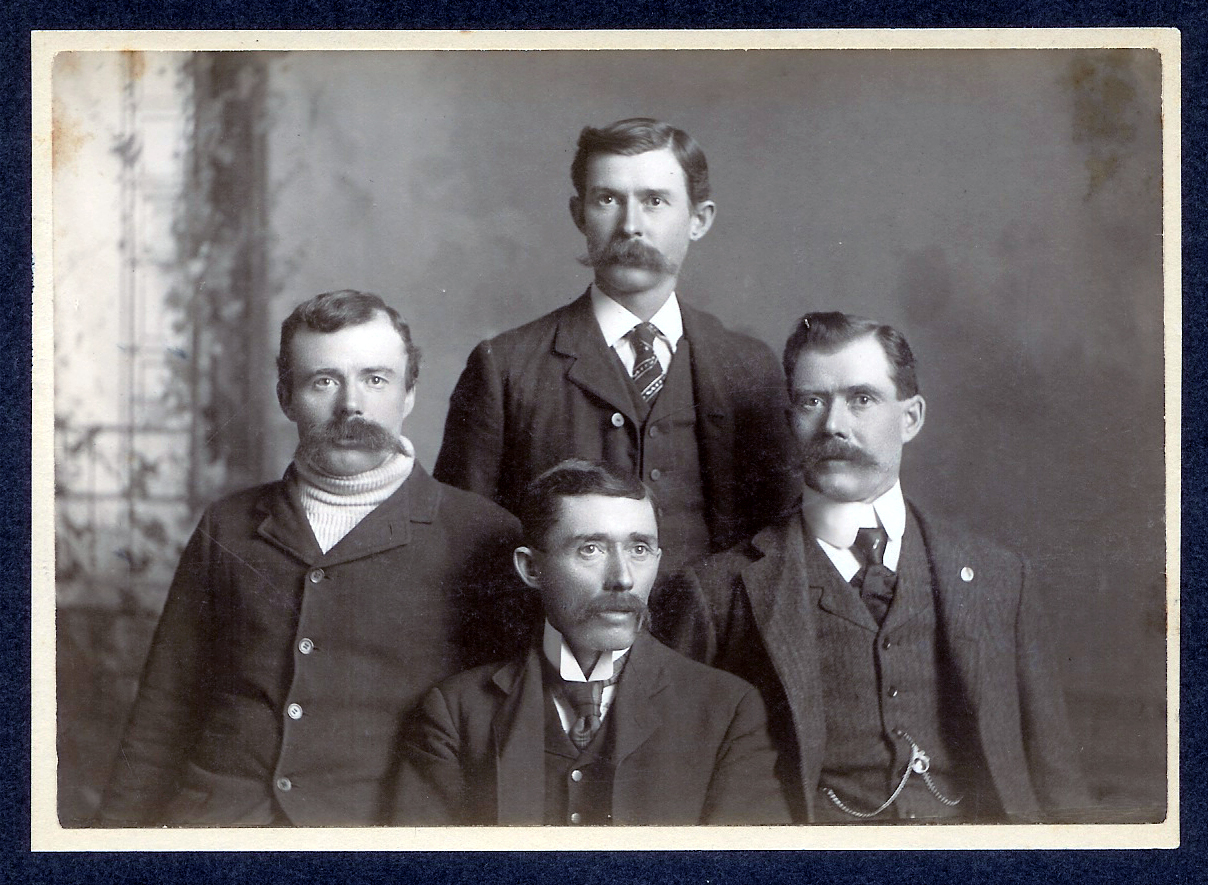
Finally, we have a fantastic family photo of four O'Neill sons. Check out those mustaches! They are to the best I can determine (left to right) James Alexander, David Edward (seated), Anthony Andrew (standing), and Thomas Matthew.


  That's all I have! 

Tuesday, April 10, 2012

Death of Thomas Crutchley...April 8, 1710

I lost this post when I was in the midst of writing it on April 8th...but I found it!

It's been awhile since I posted on this blog. I initially started it to relate some family history to my cousins and haven't really done much with it since then...but I recently started looking over some other items and decided to continue the history based upon anniversary dates.

So today's ancestor is Thomas Crutchley. He was born in 1651 probably in Annapolis, in Anne Arundel County, Maryland and died 302 years ago in the same location...so 1651-1810.

Thomas Crutchley is my 9x Great Grandfather on my Mother's Father's side.
  • Barbara (1939-2005), daughter of Robert George Metcalf and Henrietta Josefina Ceseña (Verdugo daughter);
  • Robert (1918-1999), the son of Charles Henry Metcalf(e) [he's the one that lost the 'e' due to some legal issues] and Alma Marie Luther;
  • Charles (1892-1968); the son of Charles H. Metcalfe and Olive "Ollie" A. Garrison;
  • Charles H. (1865-1926), the son of George W. and Mary A. (or Martha) Metcalfe;
  • George (1810-aft 1880), the son of William J. and Jemina;
  • William (1788-1869), the son of John Metcalfe (the 'e' magically appears] and Prudence Clark;
  • John (1767-1835), the son of William Isaac Metcalf  and Esther (or Hester) Braselton;
  • William Isaac (1745-1825), the son of John Metcalf and Mary Polly Norris;
  • John (1710-1757), the son of John Metcalf and Lydia Crutchley;
  • And Lydia (1682-1740), the daughter of Thomas Crutchley and Margaret Baldwin.
What do we know about Thomas Crutchley? He was an attorney in Annapolis. He married Margaret Baldwin, Daughter of John Baldwin & Elizabeth Lusby...the Baldwins were a Quaker family and John Baldwin was supposedly a descendent of John Baldwyn, The Hero of 1622.

John Baldwyn was the hero of 1622 during the Indian massacre in Virginia. He became a Quaker and can be traced back to Jamestown. He came on the ship Tyger, the same ship that brought the colony treasurer, Lord Sandys to Jamestown.  Sandys had Parliamentary approval to round up "50 London Orphans" to bring to Jamestown.  At that time, an orphan was any young person with no discernable father; (he might have a mother).  John Baldwyn's grandson said that his grandfather came on that ship as an orphan.  Later in 1622, the last big Indian attack occurred.  Master John Baldwin was credited with alarming the colony by firing his musket and was rewarded with a purse of gold.

The Baldwin Family traces their descent from Bawdewyn, who are named in the roll of Battle Abbey as one of the companions of William the Conqueror and afterwards were Castellans of Montgomery from whom that town acuired it's Welsh appellation of Tre-Baldwin of town of Baldwin.

Thomas & Margaret Crutchley's children were:
  • Our ancestor: Lydia CRUTCHLEY; born before Jun 1684; married John METCALF before Nov 1709.
  • Thomas CRUTCHLEY, born 27 Jan 1685 at St. James Parish, Anne Arundel Co., MD; married Dinah HARWOOD.
  • Ruth CRUTCHLEY; born circa 1690; married Richard WARFIELD before Nov 1709.
  • Beatrice CRUTCHLEY; born before 1709.
  • Eliza CRUTCHLEY; born before Nov 1709